Updated Oct 26, 2026
Why Halloween has so many symbols
Walk past any store in October and you will see the same images again and again: grinning pumpkins, arched black cats, bats against a big yellow moon. These symbols did not come from a single source. Some reach back to the harvest season and the old Celtic festival of Samhain. Others come from European beliefs about witches and death, from Shakespeare and Victorian ghost stories, and a few were invented by American candy makers, card printers and Hollywood in the last 150 years.
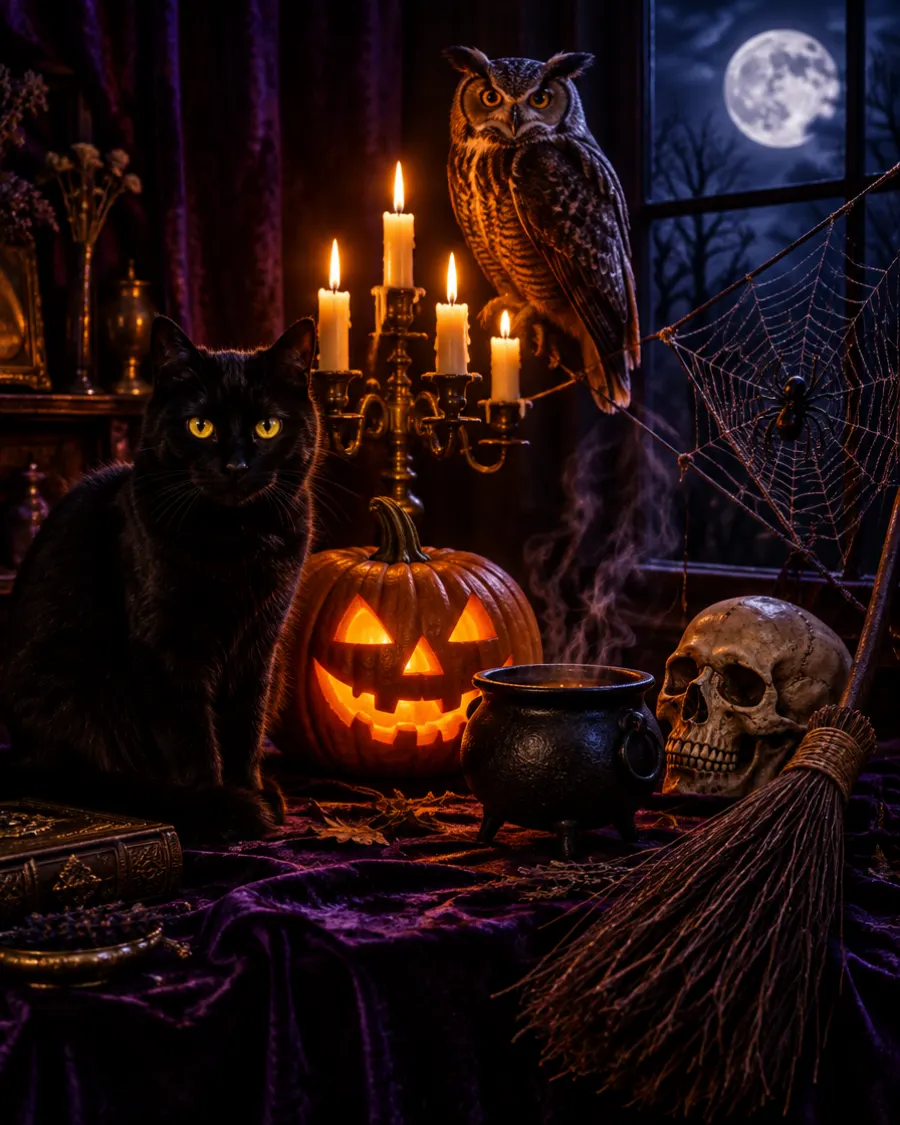
A useful way to think about them: most Halloween symbols fit one of three themes — the harvest (pumpkins, scarecrows, corn, the autumn moon), death and the dead (skeletons, ghosts, skulls) and night creatures and magic (bats, owls, spiders, black cats, witches). Below we go through the most common ones and separate what historians can say from what is simply folklore.
Jack-o’-lanterns
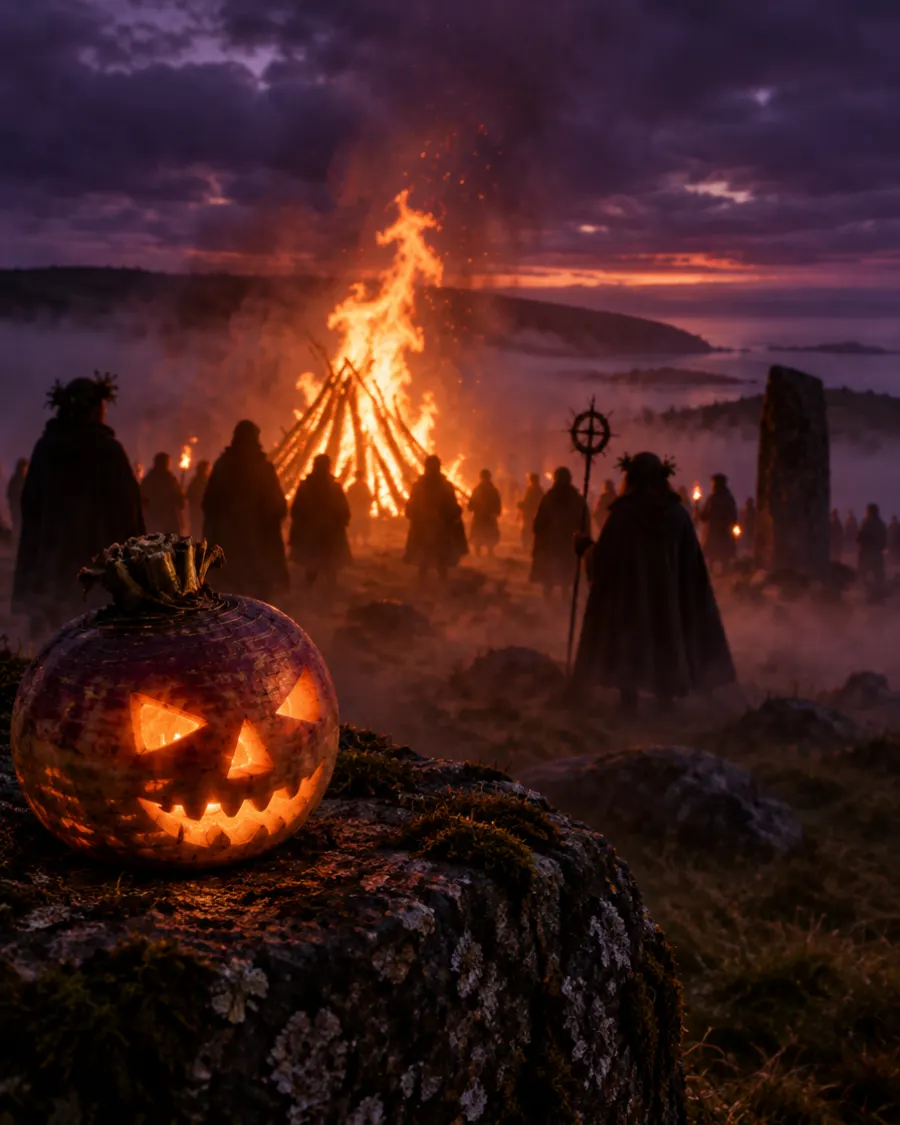
The carved pumpkin is the single most recognizable Halloween symbol. Its name comes from an Irish folk tale about Stingy Jack, a man who tricked the Devil and was left to wander the earth with only a coal inside a hollowed turnip to light his way. That story is a legend, not history — but the practice it explains is real. People in Ireland and Scotland carved faces into turnips and other root vegetables at Halloween, and Irish and Scottish immigrants in North America switched to the larger, softer native pumpkin.
So the jack-o’-lantern means two things at once: a harvest decoration and a light meant to keep wandering spirits away. Read the full story and carving tips in our jack-o’-lantern guide.
Black cats
Black cats became tied to Halloween through their long, unlucky association with witches in Europe. In the late Middle Ages and early modern period, as fear of witchcraft spread, cats — especially black ones — were often described as a witch’s companion or “familiar,” and in some tales as a witch in disguise. Those beliefs crossed the Atlantic with European settlers.
Not every culture sees black cats as bad luck. In parts of Britain and Ireland, a black cat crossing your path has traditionally been seen as a good sign, and sailors once considered ship’s cats lucky. On Halloween, the black cat is mostly a visual shorthand for magic and mystery.
Many animal shelters are cautious about adopting out black cats in the days around Halloween, worried about pets being taken as props. If you love the look, a cat-ear headband is a kinder costume accessory.
Advertisement
Bats and owls
Bats are night animals, and that alone makes them a natural fit for a holiday about darkness. A popular explanation links them to Samhain bonfires: the fires drew insects, and the insects drew bats swooping through the firelight. That idea is plausible but hard to prove. What is certain is that the 19th-century vampire stories — and later Dracula films — made the bat a lasting symbol of the spooky and the undead. In reality, most bats in North America are harmless insect-eaters that help control mosquitoes.
Owls also hunt at night, and their silent flight, glowing eyes and eerie calls gave them a mixed reputation. In parts of medieval Europe, an owl’s hoot near a home was thought to warn of death, and owls were sometimes linked to witches. In other traditions — like the ancient Greek link between the owl and the goddess Athena — the owl stands for wisdom. On Halloween cards it usually just means “night has fallen.”
Spiders and spiderwebs
Spiders tap into one of the most common human fears, and their webs suggest a place that has been abandoned for a long time — a dusty attic, an empty house, a forgotten grave. That is why fake cobwebs are one of the cheapest and most effective Halloween decorations. In autumn, many garden spiders are also at their largest and most visible, spinning big orb webs across porches and bushes just as Halloween arrives.
Spiders also show up in European folklore as ingredients in witches’ brews and as omens. Today a spider on a web is a friendly kind of creepy — scary enough for a decoration, but harmless.
Witches and broomsticks
The Halloween witch — pointed hat, black dress, broomstick and a bubbling pot — is a mix of very old beliefs and much newer pictures. Fear of witchcraft was real and deadly in Europe and colonial America, where accused people (most of them women) were put on trial and executed, including at Salem, Massachusetts in 1692. That dark history is worth remembering behind the cartoon image.
The broom has an everyday origin: it was a household tool closely tied to women’s work, so stories of witches flying on brooms turned a familiar object into something magical. One of the earliest known pictures of women riding brooms appears in the margins of a 15th-century French manuscript. The tall pointed hat and green-faced witch became fixed in American popular culture much later, through illustrated books, postcards and especially The Wizard of Oz film (1939).
Skeletons, skulls and ghosts
Halloween sits right before All Saints’ Day and All Souls’ Day (November 1 and 2), when Christians have long remembered the dead. Skeletons and skulls are the most direct reminder of death. In medieval and Renaissance art, a skull was a memento mori — a reminder that life is short — and the “dance of death” showed skeletons leading people of every rank away. Mexico’s Día de los Muertos uses skulls very differently, as cheerful and loving images of remembered family; see our Halloween around the world guide.
Ghosts come from the old belief, found in Samhain lore and many other cultures, that the spirits of the dead could return around this time of year. The classic white-sheet ghost likely grew out of the burial shroud — the cloth used to wrap a body — and became a simple costume anyone could make. Ghost stories told by the fire were part of Halloween long before horror movies; you can find more in our legends page.
Cauldrons
A cauldron was simply a large cooking pot hung over an open fire — something every household once used. In folklore and literature, though, it became the witch’s pot for brewing spells. The most famous example is the three witches in Shakespeare’s Macbeth (first performed in the early 1600s), who chant “Double, double toil and trouble” as they throw strange ingredients into a boiling pot. You can read that passage on our Halloween poems page.
Today cauldrons hold candy at the door or punch at a party — see the bubbling cauldron punch on our recipes page.
Candy corn, scarecrows and the harvest
Candy corn is the newest symbol on this list. It was created in the 1880s in Philadelphia, generally credited to George Renninger of the Wunderle Candy Company, and was originally sold as a farm-themed candy — at a time when many Americans thought of corn as chicken feed. Its tie to Halloween came later, in the mid-20th century, as trick-or-treating spread. More in our Halloween candy guide.
Scarecrows stood in fields for centuries to protect crops from birds. Because Halloween grew out of harvest festivals, the stuffed figure in a straw hat fits right in with pumpkins, hay bales and corn stalks. Writers and filmmakers later made the scarecrow a little sinister — a figure that might come to life after dark.
Vampires, Frankenstein’s monster, werewolves and mummies
Many of the monsters we now link with Halloween came from 19th-century novels and 20th-century films, not ancient festivals. Mary Shelley’s Frankenstein was published in 1818, and Bram Stoker’s Dracula in 1897. When Universal Pictures released film versions of Dracula and Frankenstein in 1931, followed by The Mummy in 1932, the flat-topped green-tinged monster, the caped vampire and the bandaged mummy became instantly recognizable costumes.
Werewolves are much older. Stories of people turning into wolves appear in ancient Greek and Roman writing and in European folklore for centuries, and some medieval and early modern trials even accused people of being werewolves. The idea that a werewolf changes under the full moon and can be stopped by silver was popularized largely by later fiction and films.
Zombies have roots in Haitian folk belief, but the flesh-eating zombie of modern horror is mostly a movie creation of the late 20th century. All of these monsters fit Halloween’s theme of the dead and the unnatural — which is why they fill costume aisles every fall. Browse classic monster looks in our costume guide and our movie guide.
Orange and black, and the full moon
Orange and black are Halloween’s official-feeling colors, but there is no ancient rule behind them. The usual explanation is symbolic: orange for the autumn harvest — pumpkins, leaves and firelight — and black for night, darkness and death. These colors were heavily used on American Halloween postcards, party goods and decorations from the early 1900s on, which helped lock them in. Purple and green have joined in more recently, often for witches and potions.
A big full moon appears on almost every Halloween poster, but a real full moon on October 31 is uncommon. (2020 was one memorable year, when a full moon fell on Halloween night.) The moon belongs in the picture because it lights up silhouettes of bats, witches and bare trees — and because old stories connected the full moon to werewolves and strange behavior.
- 1HarvestPumpkins, scarecrows, corn, orange, the autumn moon
- 2The deadSkeletons, skulls, ghosts, graveyards
- 3Night and magicBlack cats, bats, owls, spiders, witches, cauldrons, black
Frequently asked questions
Why are black cats associated with Halloween?
In late medieval and early modern Europe, black cats were often described as witches’ companions or even witches in disguise. Those beliefs traveled to America and tied black cats to Halloween’s witch imagery.
Why are orange and black the colors of Halloween?
There is no single historic rule. Orange is usually linked to the harvest and autumn, and black to night and death. Early 1900s American postcards and party decorations made the pairing standard.
Why are bats a Halloween symbol?
Bats are night animals, which suits a holiday about darkness. Vampire stories and Dracula films later made them a lasting spooky symbol. A popular but unproven theory says bats were drawn to insects around Samhain bonfires.
Is there always a full moon on Halloween?
No. A full moon on October 31 is fairly rare — 2020 was one recent example. The moon appears in Halloween art mainly as a dramatic backdrop.
Advertisement